Healthcare OS · Risk Stratification
Risk scores you can trust, defend, and act on.
Most risk stratification returns a static prediction in a batch report, with no way to see how it was reached. IASORA scores every patient across 34 factors, shows the weight and the source behind every contribution, proves its accuracy on your own history before go-live, and turns each risk level into governed clinical action.
0.75 to 0.80 AUROC on 30-day readmission · validated on your population before go-live · every factor traceable
A score nobody can explain is a score no clinician will act on and no board will sign off.
Platform sequence
From a continuous score to coordinated care.
Four steps, running on one record. Nothing here is a batch job, and nothing stops at a number.
Ingest the record
Conditions, medications, labs, vitals, encounters, care gaps and utilisation consolidated into one longitudinal FHIR record per patient.
Score the patient
A normalised 0 to 100 composite across four weighted risk areas, combining an always-on deterministic baseline, established clinical indices and a governed learned layer.
Explain the number
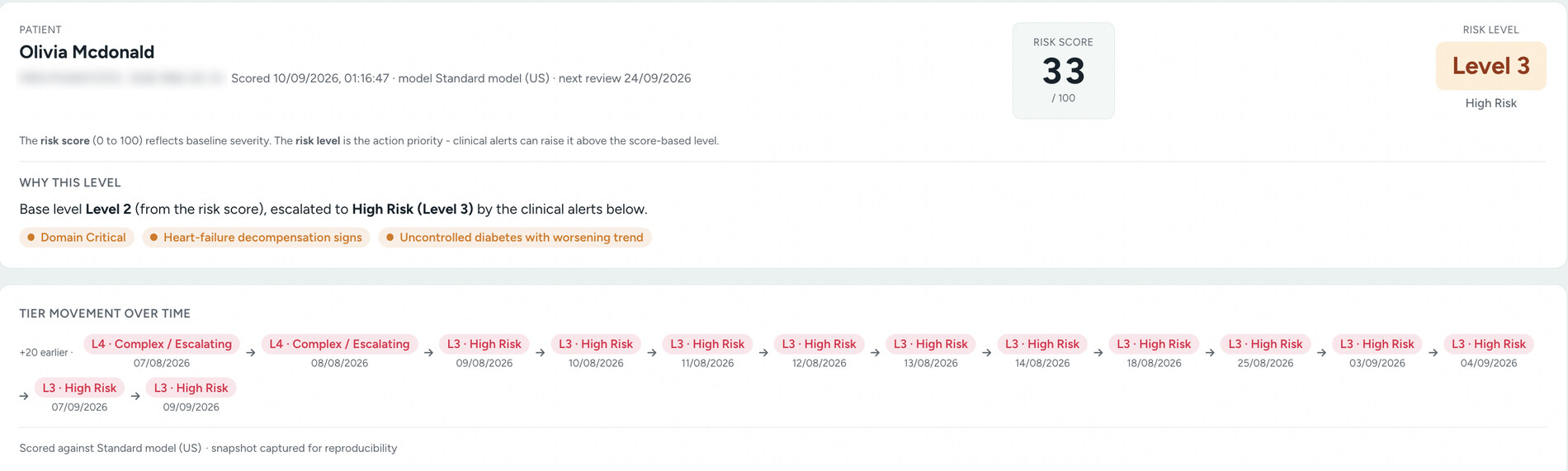
Every point traces back to the factor, the weight and the data source, with tier movement over time and the clinical triggers stated in plain language.
Trigger the care
Risk levels map to action queues. Outreach starts, response windows are enforced, and anything unanswered escalates to a care manager.
Population view
Your whole panel, stratified and current.
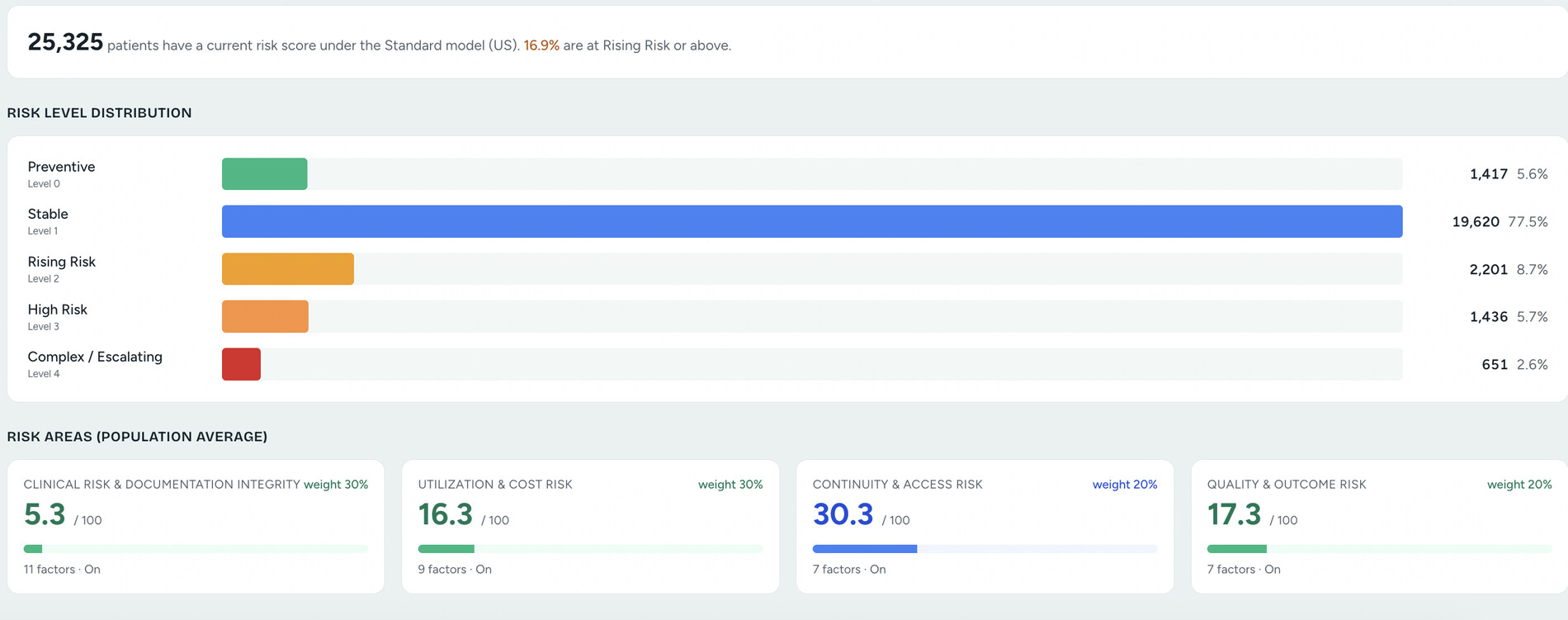
Glass-box architecture
Transparent weights. Continuous updates. One-way clinical escalation.
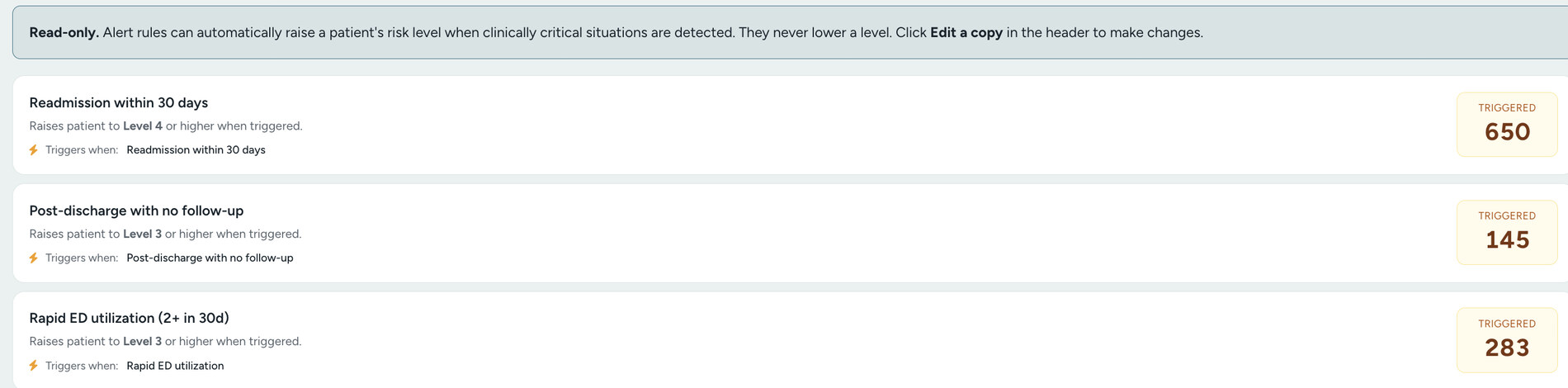
The score is a composite of four weighted risk areas across 34 factors. On top of it sit clinical alert rules that can raise a patient's action priority. By design, they cannot lower it, so an acute event is never averaged away by a settled history.
The score reflects baseline severity. The level is the action priority. Keeping them separate is what lets a readmission or a missed post-discharge follow-up raise a patient today, without quietly rewriting the score that the readmission has not yet earned.
In the product
The rule, and the patient it moved.
Operational impact
The score did not sit in a report. It triggered the care.
Platform capabilities
Everything the score needs to survive clinical, actuarial and board review.
Transparent 34-factor engine
Four weighted risk areas across 34 factors, resolved into one normalised 0 to 100 composite.
Established clinical indices
NEWS2, heart failure risk, CHA₂DS₂-VASc, eGFR on CKD-EPI 2021, Wells DVT and Morse Fall, alongside Charlson, Elixhauser, HHS-HCC, LACE and NHS eFrailty.
External model adapters
Connect a third-party or proprietary scoring engine, including ACG-compatible endpoints, without custom integration work.
Governed learned layer
An optional learned adjustment, promoted to production only after accuracy, calibration, time-split and fairness checks pass. Reversible in one step.
Continuous re-scoring
Scores recalculate as ADT feeds, results and encounters land on the FHIR pipeline, so nothing waits for a nightly batch.
Versioned model governance
Read-only standard models with tenant-tuned copies. Every weight, threshold and alert rule change is versioned with an audit diff.
Architectural distinction
Most risk stratification stops at prediction.
| Traditional risk stratification | IASORA Healthcare OS | |
|---|---|---|
| Explainability | A black-box score with weights you cannot inspect | Every factor, weight and alert rule traceable in plain language |
| Data freshness | Periodic batch runs, already stale when they land | Continuous re-scoring off the FHIR event pipeline |
| Fit to you | A generic national model applied unchanged | Validated and tuned on your own population before go-live |
| What happens next | A score in a report or a spreadsheet | Risk levels trigger tasks, outreach response windows and clinical escalation |
| Governance | Trust required, with no version history | Clone-and-edit lifecycle, versioned audit diffs, reversible learned layer |
| Model architecture | One fixed algorithm | Weighted baseline, clinical indices, external adapters and a governed learned layer |
Proven accuracy
Validated on your historical data before deployment.
Calibration and predictive accuracy are proven against your own retrospective data before any production workflow is switched on. Three outcomes are measured.
AUROC measures how well a model separates higher-risk from lower-risk patients, where 0.5 is a coin toss and 1.0 is perfect. IASORA scores between 0.75 and 0.80 on 30-day readmission in retrospective evaluation across a 323,000-patient history. Your own number is produced the same way, on your population, before go-live.
Implementation
A risk score you can defend at the board and in the clinic.
Bring a cohort and a year of history. We will validate the engine on your own data before go-live, then show you how every risk level turns into governed clinical action.