Care Hub · Population health and value-based care
Rank by what you can actually change.
Care Hub ranks your panel by preventable risk, the share a defined care action can reduce, then runs the outreach, tasks and gap closure on one patient record.
Ranked by opportunity · closed-loop SLA tracking · reconciled against your contract targets
The highest-risk patient is rarely the highest-opportunity patient.
The population health gap
Stop handing care managers patients they cannot move.
An acuity-sorted registry puts a frail 88-year-old with advanced disease at the top every month. A 61-year-old with uncontrolled diabetes and two missed PCP visits sits below the fold, where one call and an appointment would change the year.
| Registry sorted by acuity | Care Hub | |
|---|---|---|
| What ranks first | Highest risk score | Highest preventable risk |
| Why this patient | A score, with no reasoning shown | The driver, the weight and the lever, on the row |
| What the team gets | A worklist to triage by hand | An owned task with a defined next action |
| Unanswered outreach | Closes quietly when the campaign ends | Breaches SLA and escalates to a named manager |
| Contract visibility | A quarterly report, rebuilt by hand | PMPM against target and quality gates, by contract |
Preventable risk
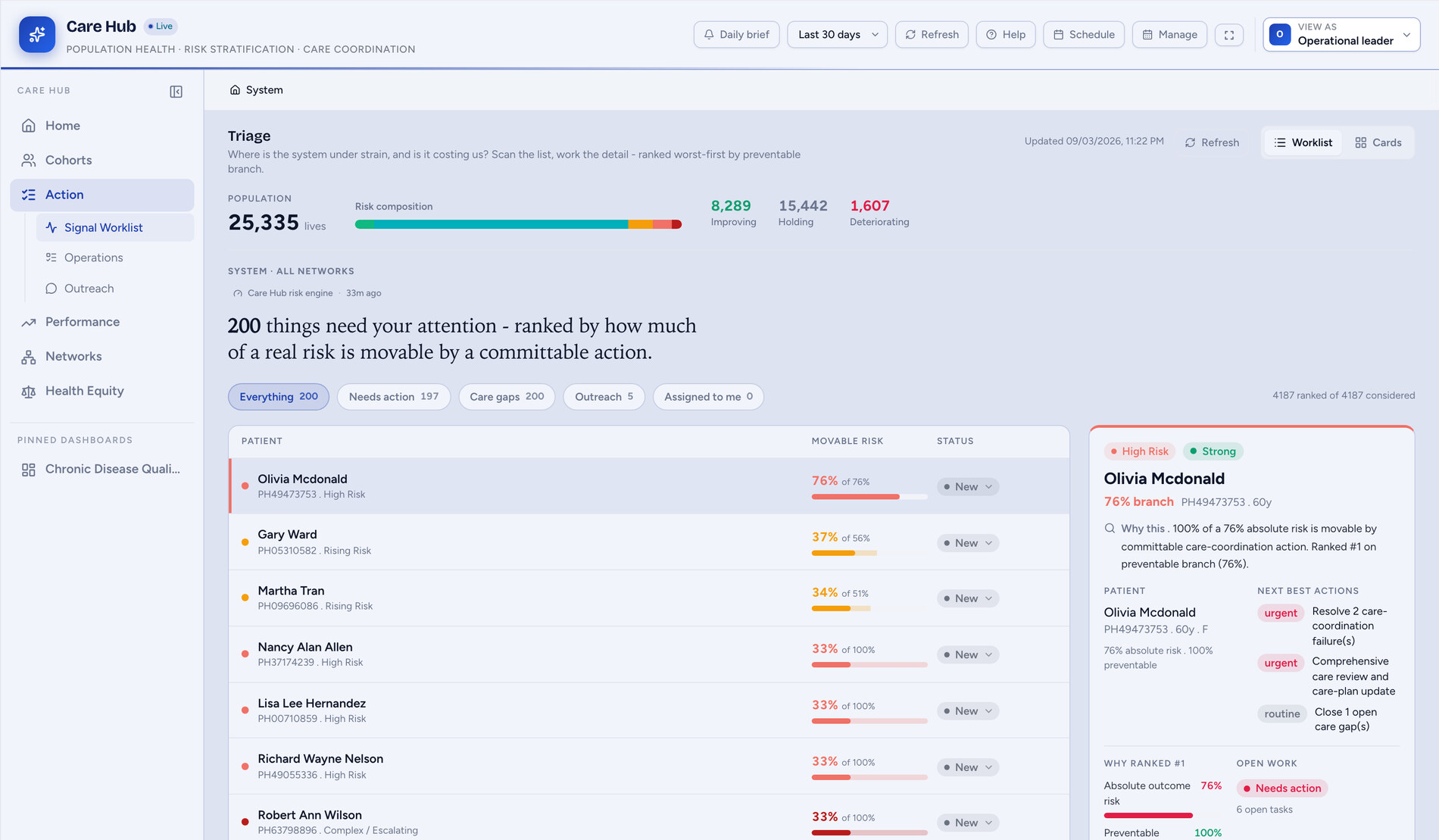
Score the risk. Rank by the share you can move.
Four steps, and every row states its reasoning in plain language.
Score the population
Clinical burden, utilisation and cost, continuity and access, and HEDIS quality risk in one composite, recalculated as results and ADT messages arrive.
Isolate what is actionable
Fixed risk is separated from the share a care team can act on: open care gaps, overdue tasks, missed follow-up.
Rank by opportunity
The worklist orders the whole attributed panel by preventable risk and shows how many were ranked out of the total considered.
State the next best action
Each patient carries ranked actions by urgency, each one click from a task, a care plan or an outreach thread.
Closing the loop
Outreach that escalates instead of expiring.
Care Hub opens outreach from the worklist on SMS, WhatsApp or AI voice in the patient's language, books the visit and tracks every thread to an SLA. Unanswered threads escalate to a named care manager and are labelled unverified, never counted as contact made.
Every task has a name on it
Care gaps, referrals, medication reconciliation and post-discharge follow-up become tasks with an owner, a due state and a queue.
Agents draft, people approve
Agents prepare the outreach and the task. Nothing reaches a patient without staff approval, and the audit trail records who approved it.
Outcomes, not activity
The home screen shows, year to date, what completed actions returned in avoided admissions, ED visits and cost.
One record, end to end
From risk signal to closed gap, without leaving the record.
No exports and no second system. The gap that closes at step seven is the same resource the risk engine opened at step two.
Organisational alignment
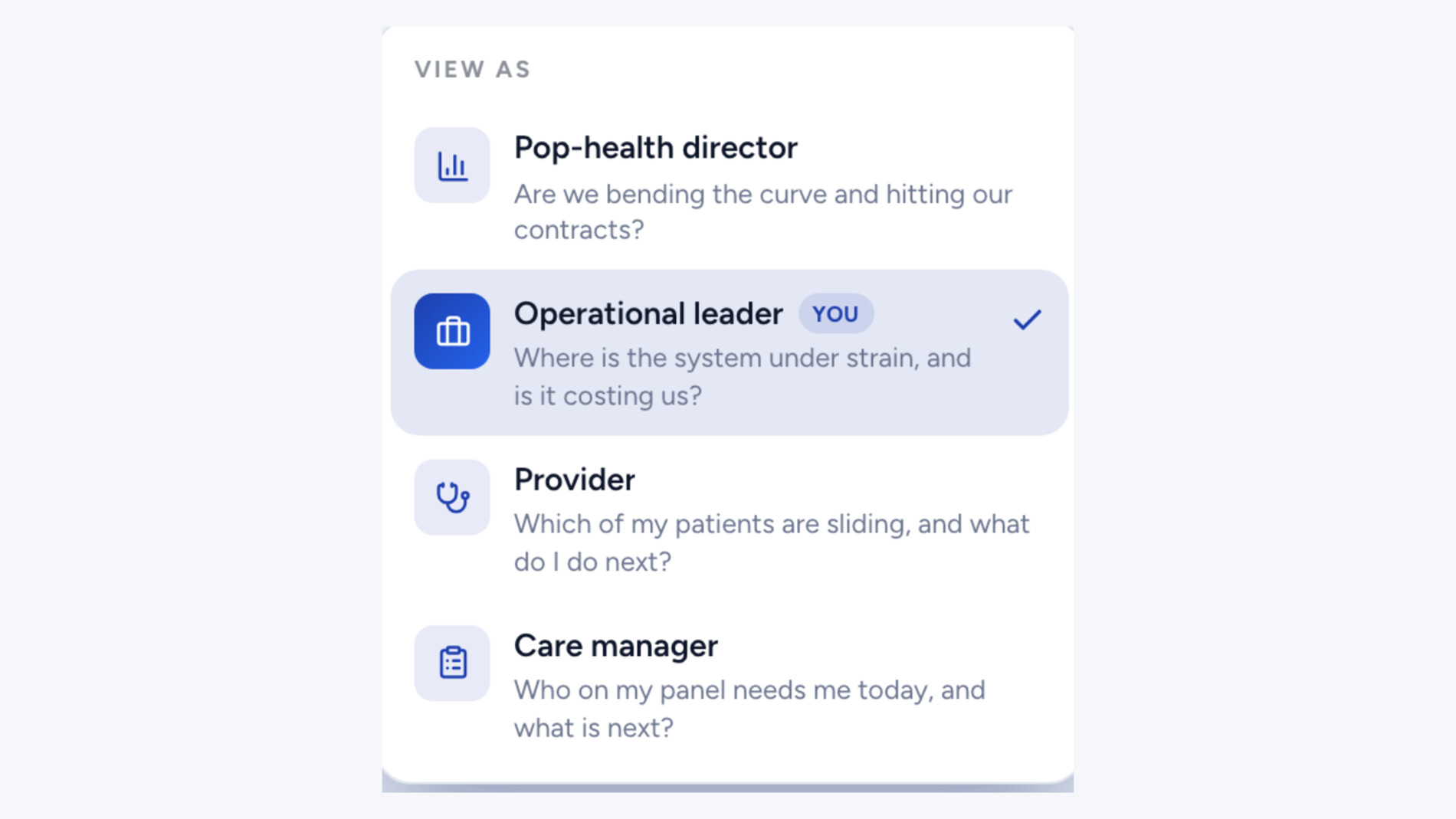
One workspace, a view for each role.
Each view opens on the question that role has to answer. The board's number and the team's worklist come from the same record, so they cannot drift apart.
Are we bending the curve and hitting our contracts?
- Contract performance, quality gate attainment and benchmark comparison
- Which way the population moved, and what the interventions returned
Where is the system under strain, and is it costing us?
- Capacity and backlog by queue, tracked against avoidable utilisation
- The queue holding up the rest, named rather than totalled
Who on my panel needs me today, and what is next?
- Assigned cases ranked by opportunity, not by acuity
- A defined next action on each, one click from being owned
Which of my patients are sliding, and what do I do next?
- Open care gaps to close at the point of care, inside the EHR
- The attributed panel and what is driving its risk
Contract performance
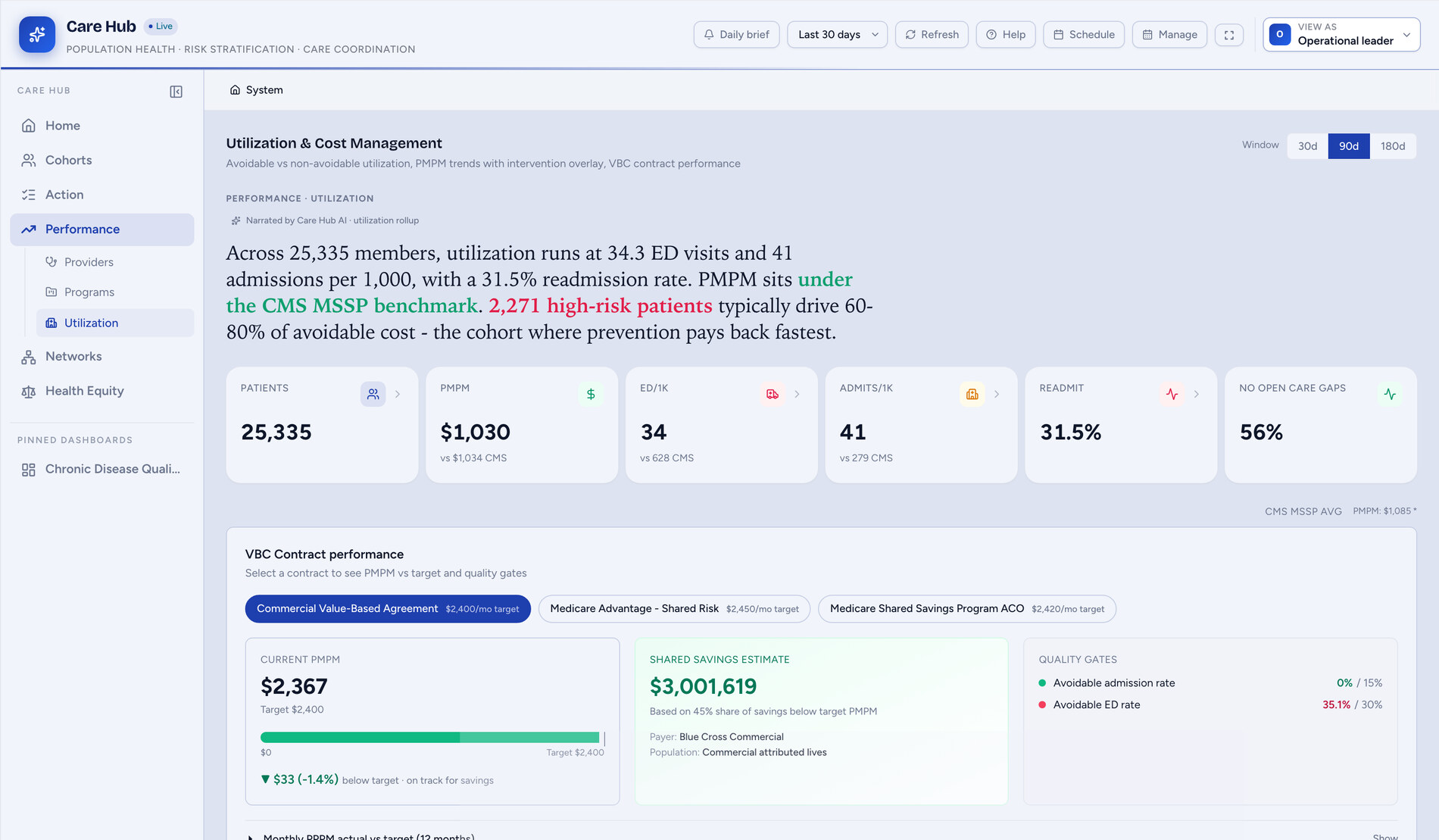
Act on a failing gate before the quarter closes.
Care Hub tracks each contract's target PMPM, shared-savings split and quality gates from the record your team worked. Avoidable utilisation is classified against CMS ambulatory care sensitive conditions, AHRQ prevention quality indicators and HEDIS, and priced on your rate card.
Single record infrastructure
Runs on the chart your clinicians already use.
Care Hub runs natively on the IASORA patient record, not a copy of your data, and renders inside your EHR through CDS Hooks and SMART on FHIR. Providers see the gap in their workflow, and nobody re-enters anything.
Accountable under a value-based contract?
Five short films follow one episode or performance year from attribution to outcome, across TEAM, CJR, MSSP, EOM and KCC.
Where the risk score comes from
Every factor traces to its weight and source, and the model is validated on your own history before go-live.
Data ingestion
Clinical data on day one. Claims files when they land.
Risk ranking, care gaps, cohorts and outreach run on clinical data from day one, from HL7 v2, FHIR, ADT feeds or flat files. Payer claims files (CCLF or 837) strengthen total cost of care, PMPM and benchmarking, and add post-acute spend. Every report states its data source.
Commercial model
Population health, without the PMPM tax.
Population health, risk stratification, value-based contract performance, cost intelligence and the agent platform are priced against an outcome. No per-member-per-month fee that grows with your panel, and no charge to ingest your own data.
Questions
What teams ask before they start.
How is preventable risk different from a standard risk score?
A risk score estimates the likelihood of an adverse event. Preventable risk is the portion of that likelihood a defined care action could reduce. Care Hub ranks on preventable risk.
Can we see how a score was calculated?
Yes. Every score traces to its factors, weights and data sources, explained in plain language on the patient. Model changes are versioned and auditable, and the model is validated on your own history before go-live.
Do we need a payer claims feed to launch?
No. Risk stratification, care gaps, cohorts and outreach run on clinical EHR and encounter data from day one. A claims feed strengthens total cost of care and PMPM, and is the main additional integration for an ACO deployment.
How is Care Hub priced?
No per-member-per-month fee and no data ingestion charge, so cost does not grow with your attributed panel. Care Hub is priced against outcomes and platform value; the day-to-day clinic apps are priced per location on Free, Starter and Pro.
Get started
Point your care team at the patients they can move.
Bring a cohort you manage today. We will show how Care Hub ranks it, assigns next actions and tracks it against your contract targets.