Care Hub · Population health and value-based care
Rank by what you can actually change.
Traditional population health hands care managers the sickest patients on the panel. Care Hub ranks by preventable risk, the portion of risk a defined care action can reduce, then runs the outreach, the tasks and the gap closure on one FHIR record.
Ranked by opportunity · closed-loop SLA tracking · reconciled against your contract targets
The constraint is not identifying risk. It is that the highest-risk patient is rarely the highest-opportunity patient.
The population health gap
Stop giving care managers lists of patients they cannot move.
Most platforms ingest claims, labs, ADT feeds and EHR data, score risk, and output a registry sorted by acuity. A frail 88-year-old with advanced disease sits at the top every month, even though care management cannot alter the trajectory. Meanwhile a 61-year-old with uncontrolled diabetes and two missed PCP visits sits below the fold, where a single call and an appointment would change the year. You fund the hours either way. Only one of them reaches your PMPM.
| Registry sorted by acuity | Care Hub | |
|---|---|---|
| What ranks first | Highest risk score | Highest preventable risk |
| Where your capacity goes | The top of an acuity list | The patients whose risk can still be reduced |
| Why this patient | A score, with no reasoning shown | The driver, the weight and the lever, on the row |
| What the team gets | A worklist to triage by hand | An owned task with a defined next action |
| Unanswered outreach | Closes quietly when the campaign ends | Breaches SLA and escalates to a named manager |
| Contract visibility | A quarterly report, rebuilt by hand | PMPM against target and quality gates, by contract |
Preventable risk
Absolute risk, then the share of it a defined care action would move.
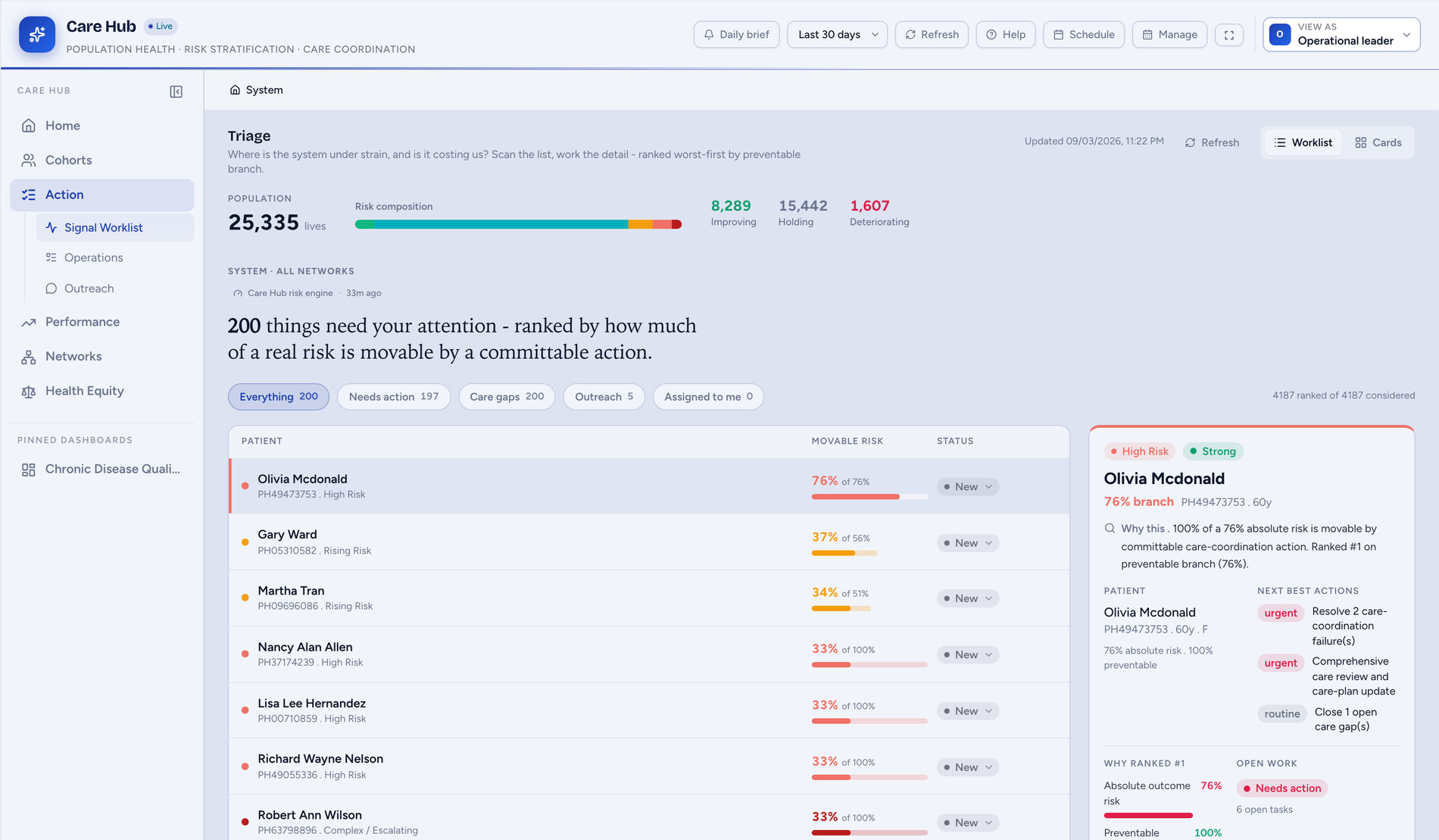
Care Hub scores every attributed patient across clinical burden, utilisation and cost, continuity and access, and quality risk. It then separates the part of that risk driven by things a care team can act on, such as an overdue HbA1c, a missed transitions-of-care call or a medication adherence gap, from the part that is fixed. Patients are ranked by opportunity, and every row states its reasoning in plain language.
Score the population
Established clinical indices sit alongside utilisation, access and HEDIS quality risk in one composite, recalculated as new results and ADT messages arrive.
Isolate what is actionable
The engine separates fixed outcome risk from the preventable fraction attributable to open care gaps, overdue tasks and missed follow-up on the patient's FHIR record.
Rank by opportunity
The worklist orders the whole attributed panel by that preventable fraction, showing how many patients were ranked out of the total considered.
State the next best action
Each patient carries a ranked set of actions with operational urgency, each one a single click to a task, a care plan or an outreach thread.
Closing the loop
Outreach that escalates instead of expiring.
A ranked list is only useful if the work leaves it, and the most expensive way to work one is a care manager with a phone list. Care Hub opens outreach from the worklist on SMS, WhatsApp or an AI voice call in the patient's language, books the visit onto the clinic calendar, and tracks every thread to an SLA. When a conversation goes unanswered it escalates to a named care manager rather than closing quietly. A thread that breached without a confirmed reply is labelled unverified, so reachability is never miscounted as contact made.
Every task has a name on it
Care gaps, referrals, medication reconciliation and post-discharge follow-up become tasks with an owner, a due state and a queue.
Agents draft, people approve
Care gap agents prepare the outreach and the task. Nothing reaches a patient without staff approval, and the audit trail records who approved what.
Outcomes, not activity
The home screen carries a year-to-date summary of what the actions already taken returned, in avoided admissions, avoided ED visits and cost.
One record, end to end
From risk signal to closed gap, without leaving the record.
This is the loop the rest of the page describes, drawn once. Each stage writes to the same FHIR resources the next stage reads, which is why the gap closes on the chart rather than in a spreadsheet, and why the outcome reaches the contract without anyone rebuilding it.
No exports between stages, and no second system to reconcile. The gap that closes at step seven is the same resource the risk engine opened at step two.
Organisational alignment
One product. The exact answer each leader needs.
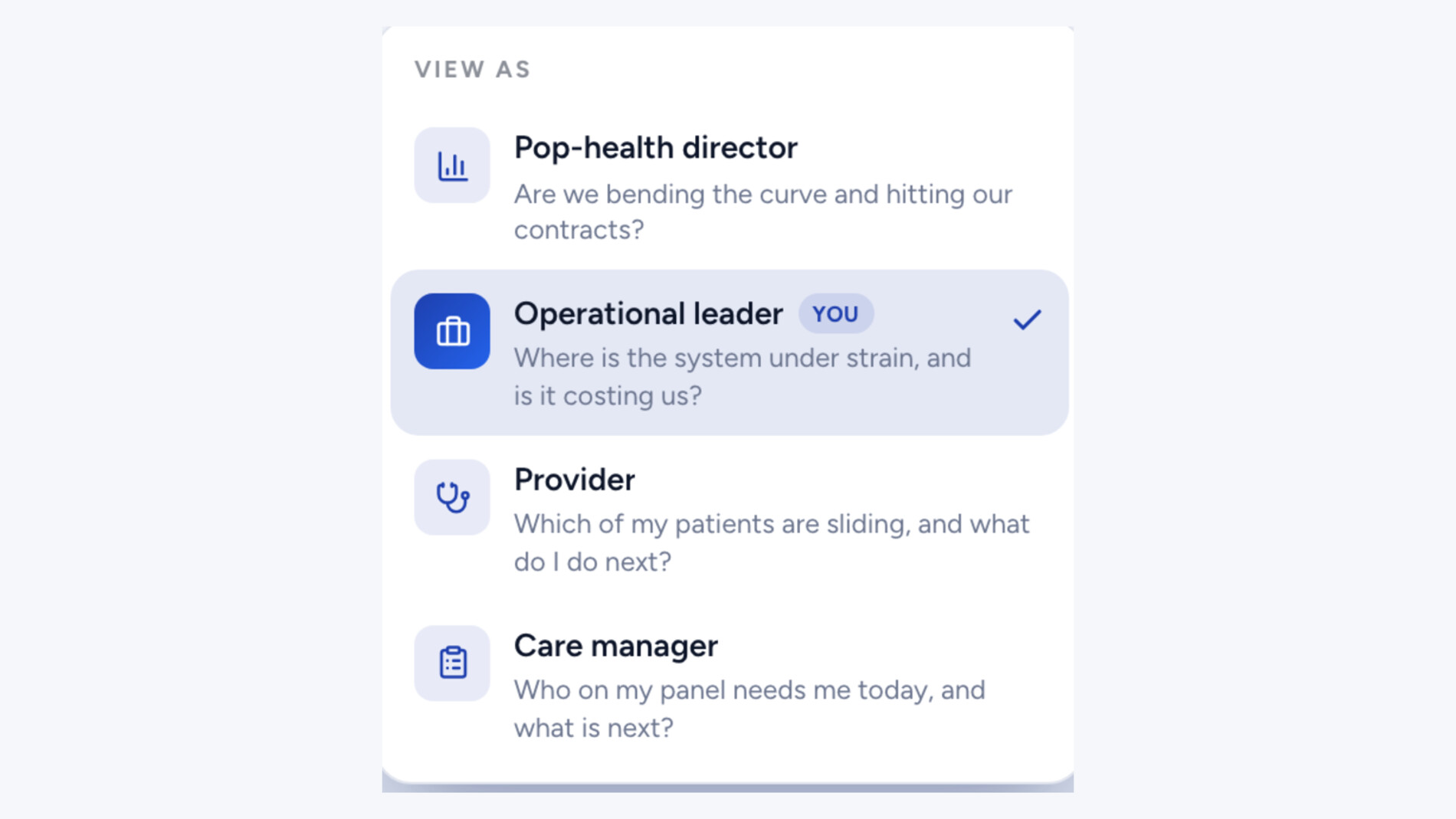
One workspace, four views, each landing on the operational or financial question that role needs to answer. The strategy set at the top becomes the care manager's morning queue and the gap the provider sees at the encounter, so the number reported to the board and the number the team works from cannot drift apart. Every screen states the finding in a sentence, names the lever, and shows the denominator behind it.
Are we bending the curve and hitting our contracts?
- Contract performance, quality gate attainment and benchmark comparison
- Which way the population moved, and what the interventions returned
Where is the system under strain, and is it costing us?
- Capacity and backlog by queue, tracked against avoidable utilisation
- The queue holding up the rest, named rather than totalled
Who on my panel needs me today, and what is next?
- Assigned cases ranked by opportunity, not by acuity
- A defined next action on each, one click from being owned
Which of my patients are sliding, and what do I do next?
- Open care gaps to close at the point of care, inside the EHR
- The attributed panel and what is driving its risk
Contract performance
Where clinical work meets contract economics.
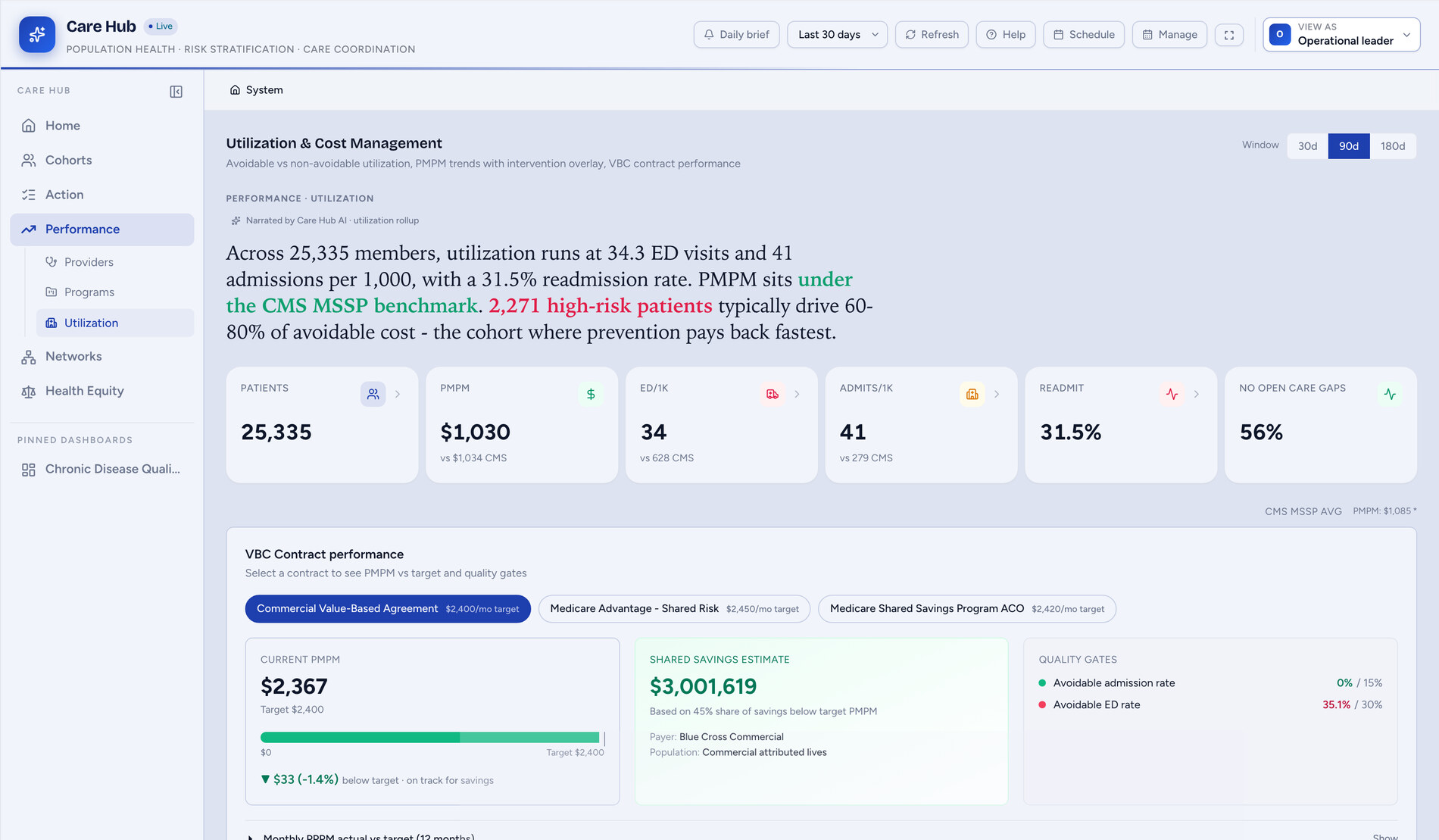
Care management that cannot be tied back to a contract is difficult to fund for a second year. Care Hub treats contracts as first-class objects, tracking target PMPM, shared-savings splits and quality gates, so the case you take to the board is built from the same record your team worked rather than assembled by hand the week before. Avoidable utilisation is classified against CMS ambulatory care sensitive conditions, AHRQ prevention quality indicators and HEDIS, and priced against your rate card. A gate about to fail is flagged while there is still time in the quarter to act.
Single record infrastructure
The same chart your care teams and clinicians already work in.
Care Hub is not an analytics overlay reading a copy of your data. It runs natively on the IASORA FHIR record, and it renders inside your existing EHR through CDS Hooks and SMART on FHIR, so the provider sees the gap without leaving their workflow and nobody re-enters anything.
Accountable under a value-based contract?
Five short films follow one episode or performance year from attribution through to outcome, on the surfaces your team would actually use, across TEAM, CJR, MSSP, EOM and KCC.
Where the risk score comes from
Every factor traces to its weight and its source, the model is validated on your own history before go-live, and the learned layer is promoted only on proven accuracy.
Data ingestion
Clinical data on day one. Claims files when they land.
Care Hub ingests HL7 v2, FHIR, ADT feeds and flat files to run risk ranking, care gaps, cohorts and outreach on clinical encounter data immediately. Total cost of care, PMPM and multi-year benchmarking strengthen when payer claims files arrive, a CCLF or an 837, and that is the primary additional integration required. Every report states the data source it was calculated from. Post-acute utilisation arrives with the same claims feed, so until it does Care Hub coordinates post-acute care through referrals, tasks and follow-up, but does not report what a SNF or home health agency billed.
Commercial model
Population health, without the PMPM tax.
Population health, risk stratification, value-based contract performance, cost intelligence and the agent platform are sold against an outcome, not a rate card. Most platforms in this category charge per member per month, so the bill grows every time your attributed panel does and success costs you more. IASORA does not price that way, and does not charge you to ingest your own data.
Questions
What teams ask before they start.
How is preventable risk different from a standard risk score?
A risk score estimates the likelihood of an adverse event. Preventable risk calculates the portion of that likelihood a defined care action could reduce. Care Hub ranks on preventable risk, so care teams stop spending their hours on cases nobody was going to change.
Can we see how a score was calculated?
Yes. Every score traces back to the individual factors, their weights and the underlying clinical data sources, with plain-language explanations on the patient. Changes to the model are versioned and auditable, and the model is validated on your own history before go-live.
Do we need a payer claims feed to launch?
No. Risk stratification, care gaps, cohort building and automated outreach run on clinical EHR and encounter data from day one. Adding a claims feed strengthens total cost of care and PMPM analytics, and it is the primary additional integration required for an ACO deployment.
How is Care Hub priced?
There is no per-member-per-month software fee and no data ingestion charge. Care Hub is priced against outcomes and platform value, so your software cost does not balloon simply because your attributed panel grew. The day-to-day clinic modules are the per-clinic half of the platform and are included on every tier.
Get started
Point your care team at the patients they can move.
Bring a cohort you currently manage. We will show you how Care Hub ranks opportunity, assigns next actions, and reconciles performance against your value-based contract targets, without a PMPM tax.